
Evaluation of targeted axillary lymph node dissection in node positive breast cancer patients post neoadjuvant therapy
targeted axillary dissection in breast cancer patients
DOI:
https://doi.org/10.30944/20117582.3253Keywords:
cáncer de mama, quimioterapia neoadyuvante, ganglio centinela, receptor 2 del factor de crecimiento epidérmico humano, histopatologíaAbstract
Background:
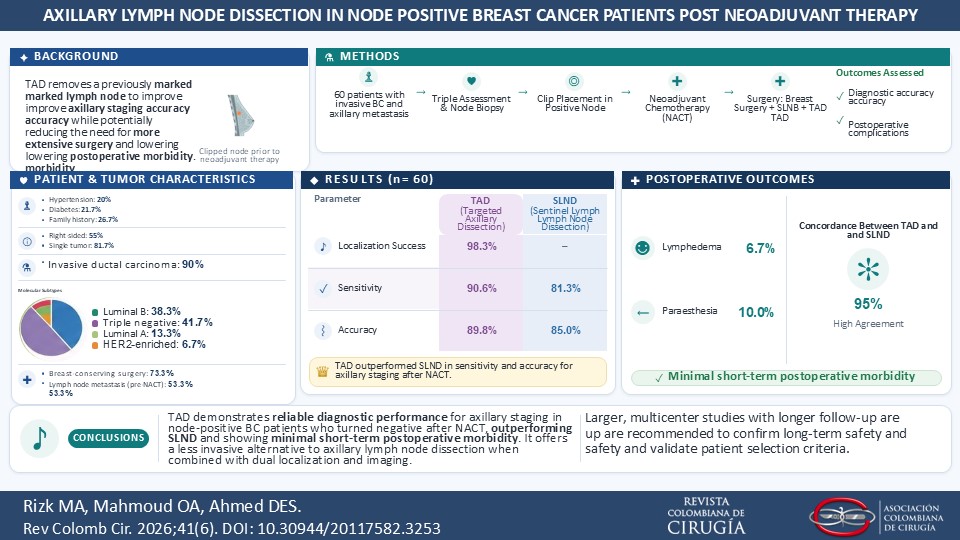
Targeted axillary dissection (TAD) involves locating and removing a previously marked lymph node to improve staging accuracy and potentially avoid more extensive axillary surgery. This study aims to assess its accuracy in axillary staging and postoperative morbidity in this setting. This study evaluates TAD in node-positive breast cancer patients after neoadjuvant therapy.
Methods:
This prospective study included 60 patients with invasive breast cancer and axillary metastasis treated at Assiut University Hospitals. Patients underwent triple assessment, biopsy, clipping of nodes, and neoadjuvant chemotherapy tailored to tumor subtype. Surgical management involved breast surgery with sentinel lymph node biopsy and targeted axillary dissection. Outcomes assessed included diagnostic accuracy, postoperative complications, and treatment response.
Results:
In this study of 60 breast cancer patients, 20% had hypertension, 21.67% diabetes, and 26.67% family history. Most tumors were right-sided (55%), single (81.67%), and invasive ductal carcinoma (90%). Molecular subtypes included luminal B (38.3%) and triple negative (41.67%). Breast-conserving surgery was performed in 73.3%, with lymph node metastasis in 53.3%. Targeted axillary dissection (TAD) achieved 98.33% localization success and showed 90.6% sensitivity and 89.8% accuracy, outperforming sentinel lymph node dissection (81.3% sensitivity, 85% accuracy). Postoperative complications were minimal (6.67% lymphedema, 10% paraesthesia), and concordance between TAD and SLND was high (95%).
Conclusions:
TAD demonstrates reliable diagnostic performance for axillary staging in node-positive breast cancer patients who turned negative after NACT, outperforming SLND and showing minimal short-term postoperative morbidity. It offers a less invasive alternative to ALND when combined with dual localization and imaging. Larger, multicenter studies with longer follow-up are recommended to confirm long-term safety and validate patient selection criteria.
Downloads
References
Díaz-Casas SE, Rosero-Díazdel Castillo FJ, MendozaDíaz S, Sáenz-Ladino A, Sánchez-Pedraza R, SilvaCárdenas SP, et al. Oncologic Outcomes of BreastConserving Surgery in a Colombian Cancer Center: An Observational, Analytical, Retrospective Cohort Study. Cancers. 2025;17:1131. https://doi.org/10.3390/cancers17071131
Sung H, Ferlay J, Siegel RL, Laversanne M, Soerjomataram I, Jemal A, et al. Global Cancer Statistics 2020: GLOBOCAN Estimates of Incidence and Mortality Worldwide for 36 Cancers in 185 Countries. CA Cancer J Clin. 2021;71:209-49. https://doi.org/10.3322/caac.21660
Allemani C, Weir HK, Carreira H, Harewood R, Spika D, Wang XS, et al. Global surveillance of cancer survival 1995-2009: analysis of individual data for 25,676,887 patients from 279 population-based registries in 67 countries (CONCORD-2). Lancet. 2015;385:977-1010. https://doi.org/10.1016/s0140-6736(14)62038-9
Banys-Paluchowski M, Gruber IV, Hartkopf A, Paluchowski P, Krawczyk N, Marx M, et al. Axillary ultrasound for prediction of response to neoadjuvant therapy in the context of surgical strategies to axillary dissection in primary breast cancer: a systematic review of the current literature. Arch Gynecol Obstet. 2020;301:341-53. https://doi.org/10.1007/s00404-019-05428-x
Caudle AS, Yang WT, Krishnamurthy S, Mittendorf EA, Black DM, Gilcrease MZ, et al. Improved Axillary Evaluation Following Neoadjuvant Therapy for Patients With Node-Positive Breast Cancer Using Selective Evaluation of Clipped Nodes: Implementation of Targeted Axillary Dissection. J Clin Oncol. 2016;34:1072-8. https://doi.org/10.1200/jco.2015.64.0094
Alamoodi M, Wazir U, Sakr RA, Venkataraman J, Mokbel K, Mokbel K. Evaluating magnetic seed localization in targeted axillary dissection for node-positive early breast cancer patients receiving neoadjuvant systemic therapy: a comprehensive review and pooled analysis. J Clin Med. 2024;13:2908. https://doi.org/https://doi.org/10.3390/jcm13102908
Ahmed M, Douek M. Targeted axillary dissection after neoadjuvant therapy in breast cancer. Br J Surg. 2018;105:313-4. https://doi.org/10.1002/bjs.10626
Sedky MK, Mostafa AA, AboElazm HA, Zaid MH. Evaluation of targeted axillary dissection in node positive locally advanced breast cancer patients with complete pathological response to neoadjuvant chemotherapy. Egypt J Surg. 2024;43:105. https://doi.org/https://doi.org/10.4103/ejs.ejs_292_23
Al-Thoubaity FK. Molecular classification of breast cancer: A retrospective cohort study. Ann Med Surg (Lond). 2020;49:44-8. https://doi.org/10.1016/j.amsu.2019.11.021
Mamtani A, Nakhlis F, Downs-Canner S, Zabor EC, Morrow M, King TA, et al. Impact of Age on Locoregional and Distant Recurrence After Mastectomy for Ductal Carcinoma In Situ With or Without Microinvasion. Ann Surg Oncol. 2019;26:4264-71. https://doi.org/10.1245/s10434-019-07693-1
Galimberti V, Cole BF, Zurrida S, Viale G, Luini A, Veronesi P, et al. Axillary dissection versus no axillary dissection in patients with sentinel-node micrometastases (IBCSG 23-01): a phase 3 randomised controlled trial. Lancet Oncol. 2013;14:297-305. https://doi.org/10.1016/s1470-2045(13)70035-4
Boughey JC, Ballman KV, Le-Petross HT, McCall LM, Mittendorf EA, Ahrendt GM, et al. Identification and Resection of Clipped Node Decreases the False-negative Rate of Sentinel Lymph Node Surgery in Patients Presenting With Node-positive Breast Cancer (T0-T4, N1-N2) Who Receive Neoadjuvant Chemotherapy: Results From ACOSOG Z1071 (Alliance). Ann Surg. 2016;263:802-7. https://doi.org/10.1097/sla.0000000000001375
Swarnkar PK, Tayeh S, Michell MJ, Mokbel K. The Evolving Role of Marked Lymph Node Biopsy (MLNB) and Targeted Axillary Dissection (TAD) after Neoadjuvant Chemotherapy (NACT) for Node-Positive Breast Cancer: Systematic Review and Pooled Analysis. Cancers (Basel). 2021;13:1539. https://doi.org/10.3390/cancers13071539
Martínez M, Jiménez S, Guzmán F, Fernández M, Arizaga E, Sanz C. Evaluation of Axillary Lymph Node Marking with Magseed® before and after Neoadjuvant Systemic Therapy in Breast Cancer Patients: MAGNET Study. Breast J. 2022;2022:6111907. https://doi.org/10.1155/2022/6111907
Hennessy BT, Hortobagyi GN, Rouzier R, Kuerer H, Sneige N, Buzdar AU, et al. Outcome after pathologic complete eradication of cytologically proven breast cancer axillary node metastases following primary chemotherapy. J Clin Oncol. 2005;23:9304-11. https://doi.org/10.1200/jco.2005.02.5023
He L, Qu H, Wu Q, Song Y. Lymphedema in survivors of breast cancer. Oncol Lett. 2020;19:2085-96. https://doi.org/10.3892/ol.2020.11307
Downloads
Published
How to Cite
Issue
Section
License
Copyright (c) 2025 Revista Colombiana de Cirugía

This work is licensed under a Creative Commons Attribution-NonCommercial-NoDerivatives 4.0 International License.
Todos los textos incluidos en la Revista Colombiana de Cirugía están protegidos por derechos de autor. Las opiniones expresadas en los artículos firmados son las de los autores y no coinciden necesariamente con las de los directores o los editores de la Revista Colombiana de Cirugía. Las sugerencias diagnósticas o terapéuticas como elección de productos, dosificación y métodos de empleo corresponden a la experiencia y al criterio de los autores.


| Article metrics | |
|---|---|
| Abstract views | 264 |
| Galley views | 65 |
| PDF Views | 65 |
| HTML views | 0 |
| Other views | 0 |




















