
Maxillofacial trauma for general surgeons: A systematic review
DOI:
https://doi.org/10.30944/20117582.3235Keywords:
maxillofacial injuries, diagnosis, diagnostic imaging, therapeutics, endovascular procedures, oral surgical proceduresAbstract
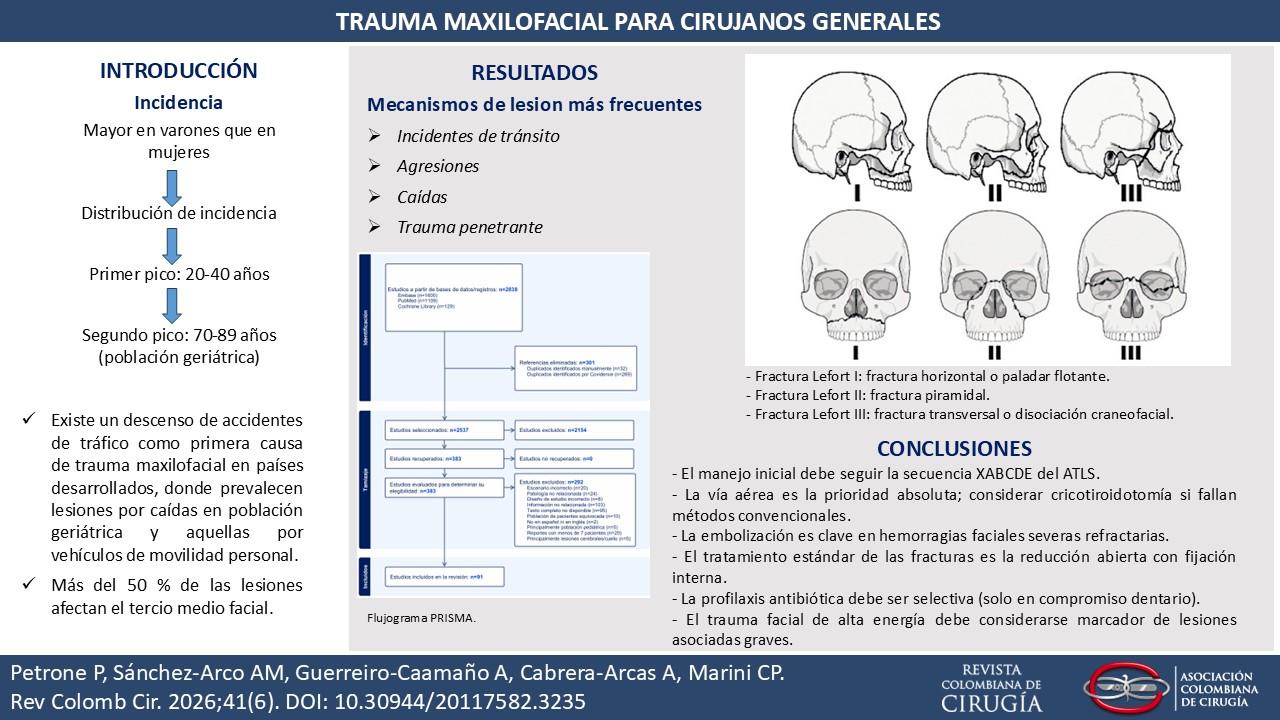
Introduction. Maxillofacial trauma can become life-threatening due to airway compromise or massive hemorrhage, as well as associated injuries. The objective of this article was to provide general and trauma surgeons with an overview of the epidemiology, diagnosis, and treatment of these injuries in settings where a maxillofacial surgeon is not always available.
Methods. A systematic literature review was conducted using PubMed, Embase, and Cochrane, covering publications from 1970 to 2024 regarding etiology, diagnostic imaging, and therapeutic strategies for adult patients with maxillofacial trauma.
Results. A decline has been observed in traffic accidents as the primary cause of maxillofacial trauma in developed countries, where injuries resulting from falls in the geriatric population and those involving personal mobility devices are now more prevalent. Maxillofacial computed tomography (CT) is confirmed as essential for accurate diagnosis. The principles of Advanced Trauma Life Support (ATLS®) must be followed, and surgical airway access may be required. Angioembolization is emerging as the solution for refractory oronasal hemorrhage. Advanced age is highlighted as a predictor for conservative management, whereas open reduction with internal fixation remains the gold standard for surgical treatment.
Conclusions. Success in the management of maxillofacial trauma depends on stabilization according to ATLS® principles, diagnosis via high-resolution CT, and a therapeutic strategy that prioritizes the preservation of function and aesthetic outcomes.
Downloads
References
Roccia F, Iocca O, Sobrero F, Rae E, Laverick S, Carlaw K, et al. World Oral and Maxillofacial Trauma (WORMAT) project: A multicentre prospective analysis of epidemiology and patterns of maxillofacial trauma around the world. J Stomatol Oral Maxillofac Surg. 2022;123:e849-e857. https://doi.org/10.1016/j.jormas.2022.05.004
Das D, Salazar L. Maxillofacial trauma: Managing potentially dangerous and disfiguring complex injuries. Emerg Med Pract. 2017;19:1-24.
Boffano P, Roccia F, Zavattero E, Dediol E, Uglešić V, Kovačič Ž, et al. European maxillofacial trauma (EURMAT) project: A multicentre and prospective study. J Craniomaxillofac Surg. 2015;43:62-70. https://doi.org/10.1016/j.jcms.2014.10.011
Bocchialini G, Ambrosi S, Castellani A, Negrini S, Zanetti U, Rossi A. Six years of experience in treating facial trauma in the province of Brescia, Italy. Craniomaxillofac Trauma Reconstruction Open. 2018;2:e61-9. https://doi.org/10.1055/s-0038-1675216
Ogunbowale A, Costello L, McCormack D, Ekanayake K, Kearns GJ. Maxillofacial fractures in females: A 5-year retrospective review. Ir J Med Sci. 2022;191:367-74. https://doi.org/10.1007/s11845-021-02534-1
Brucoli M, Boffano P, Romeo I, Corio C, Benech A, Ruslin M, et al. Epidemiology of maxillofacial trauma in the elderly: A European multicentre study. J Stomatol Oral Maxillofac Surg. 2020;121:330-8. https://doi.org/10.1016/j.jormas.2019.09.002
Çeçen S, Özgenel GY, Özbek S, Akın S, Kahveci R, Özpar R. Maxillofacial trauma in geriatric patients in an aging country. J Plast Reconstr Aesthet Surg. 2024;95:161-9. https://doi.org/10.1016/j.bjps.2024.05.040
Boschetti CE, Montella E, Magliulo R, Molo E, Canet-López E, Guida D, et al. New generation vehicles: The impact of electric scooter trauma on the severity of facial fractures assessed by FISS score. A multicentre study. Br J Oral Maxillofac Surg. 2024;62:626-31. https://doi.org/10.1016/j.bjoms.2024.05.007
Gearing PF, El-Atem N, Devine M, Chen J, Kumar R, Ramakrishnan A, et al. E-Scooter facial fractures: A comparative cohort study. J Craniomaxillofac Surg. 2024;52:1088-94. https://doi.org/10.1016/j.jcms.2024.06.021
Wasicek PJ, Gebran SG, Ngaage LM, Liang Y, Ottochian M, Morrison JJ, et al. Contemporary characterization of injury patterns, initial management, and disparities in treatment of facial fractures using the National Trauma Data Bank. J Craniofac Surg. 2019;30:2052-6. https://doi.org/10.1097/SCS.0000000000005862
Bertin E, Louvrier A, Meyer C, Weber E, Barrabé A, Pons M. An epidemiologic retrospective study of maxillofacial traumatology in the elderly. J Stomatol Oral Maxillofac Surg. 2022;123:e878-e882. https://doi.org/10.1016/j.jormas.2022.05.024
Kim EJ, Bustos VP, Lee BT. Sources of facial injury across age groups: A nationwide overview using the national electronic injury surveillance system database. J Craniofac Surg. 2023;34:1927-30. https://doi.org/10.1097/SCS.0000000000009582
Irgebay Z, Kahan EH, Park KE, Choi J, Zellner EG. Characteristics and patterns of facial fractures in the elderly population in the United States based on Trauma Quality Improvement Project Data. J Craniofac Surg. 2022;33:1294-8. https://doi.org/10.1097/SCS.0000000000008612
Lin C, Wu J, Yang C, Zhang C, Xu B, Zhang Y, et al. Classifying and standardizing panfacial trauma according to anatomic categories and Facial Injury Severity Scale: A 10-year retrospective study. BMC Oral Health. 2021;21:557. https://doi.org/10.1186/s12903-021-01900-w
McGoldrick DM, Fragoso-Iñiguez M, Lawrence T, McMillan K. Maxillofacial injuries in patients with major trauma. Br J Oral Maxillofac Surg. 2018;56:496-500. https://doi.org/10.1016/j.bjoms.2018.04.001
Punjabi SK, Khan M, Qadeer-ul-Hassan, Zaib-un-Nisa. Associated injuries with facial trauma - A study. JLUMHS. 2012;11:60-3.
Färkkilä EM, Kaban LB, Boos-Lima FBDJ, Peacock ZS. Association of craniomaxillofacial fractures and blunt cerebrovascular injuries. Int J Oral Maxillofac Surg. 2023;52:847-53. https://doi.org/10.1016/j.ijom.2022.12.003
Othman A, Al-Qahtani FAM, Al-Qahtani H, Jaber M, Bishawi K, Khamis AH, et al. Traumatic brain injuries and maxillofacial fractures: A systematic review and meta-analysis. Oral Maxillofac Surg. 2023;27:373-85. https://doi.org/10.1007/s10006-022-01076-9
Galteland P, Døving M, Næss I, Sehic A, Utheim TP, Eken T, et al. The association between head injury and facial fracture treatment: An observational study of hospitalized bicyclists from a level 1 trauma centre. Acta Neurochir (Wien). 2024;166:132. https://doi.org/10.1007/s00701-024-06019-9
Expert Panel on Neurological Imaging, Parsons MS, Policeni B, Juliano AF, Agarwal M, Benjamin ER, Burns J, et al. ACR Appropriateness Criteria® Imaging of facial trauma following primary survey. J Am Coll Radiol. 2022;19:S67-86. https://doi.org/10.1016/j.jacr.2022.02.013
Rajeev A, Pai KM, Smriti K, Kadavigere R, Kamath A, Gadicherla S, et al. Diagnostic accuracy of ultrasonography in the assessment of facial fractures. Pesqui Bras Odontopediatria Clín Integr. 2019;19:e4832. https://doi.org/10.4034/PBOCI.2019.191.133
Huang LK, Huang CS, Tu HF, Chiang KH, Bajani F, Fu CY. A prediction model for selective use of facial computed tomography in blunt head trauma patients. Plast Reconstr Surg. 2021;148:583e-591e. https://doi.org/10.1097/PRS.0000000000008371
Ricci JA, Tran BNN, Ruan QZ, Lin SJ, Singhal D, Lee BT. Comparing head and facial computed tomographic imaging in identifying operative facial fractures. Ann Plast Surg. 2018;80:S219-S222. https://doi.org/10.1097/SAP.0000000000001289
Talwar AA, Heiman AJ, Kotamarti VS, Bommareddy K, Harris ES, Sandberg ML, et al. High-resolution maxillofacial computed tomography is superior to head computed tomography in determining the operative management of facial fractures. J Surg Res. 2020;256:381- 9. https://doi.org/10.1016/j.jss.2020.06.060
Perry M. Facial injuries: Triage and applying damage control principles. Trauma. 2017;19:186-95. https://doi.org/10.1177/1460408616675643
Eng J, Sivam S. General overview of the facial trauma evaluation. Facial Plast Surg Clin North Am. 2022;30:1- 9. https://doi.org/10.1016/j.fsc.2021.08.001
Krishnan DG. Systematic assessment of the patient with facial trauma. Oral Maxillofac Surg Clin North Am. 2013;25:537-44. https://doi.org/10.1016/j.coms.2013.07.009
Durham J, Moore UJ, Hill CM, Renton T. Oral surgery II: Part 6. Oral and maxillofacial trauma. Br Dent J. 2017;223:877-83. https://doi.org/10.1038/sj.bdj.2017.995
Mohan R, Iyer R, Thaller S. Airway management in patients with facial trauma. J Craniofac Surg. 2009;20:21- 3. https://doi.org/10.1097/SCS.0b013e318190327a
Paz-Escobar MI, González-Figueroa CP. Guías de manejo del trauma facial y urgencias en otorrinolaringología. Rev Colomb Cir. 1996;11:137-55.
Perry M, Morris C. Advanced trauma life support (ATLS) and facial trauma: Can one size fit all? Part 2: ATLS, maxillofacial injuries and airway management dilemmas. Int J Oral Maxillofac Surg. 2008;37:309-20. https://doi.org/10.1016/j.ijom.2007.11.002
Le TMT, Oleck NC, Khan W, Halsey JN, Liu FC, Hoppe IC, et al. Implications of facial fracture in airway management of the adult population: What is the most effective management strategy? Ann Plast Surg. 2019;82(4S Suppl 3):S179-S184. https://doi.org/10.1097/SAP.0000000000001883
Perry M, O’Hare J, Porter G. Advanced Trauma Life Support (ATLS) and facial trauma: can one size fit all? Part 3: Hypovolaemia and facial injuries in the multiply injured patient. Int J Oral Maxillofac Surg. 2008;37:405- 14. https://doi.org/10.1016/j.ijom.2007.11.005
Stallwood-Hall C, Anderson J, Ebeid A. Systematic review and meta-analysis of arterial embolization compared with traditional management on outcomes of traumatic massive facial haemorrhage. ANZ J Surg. 2022;92:988-93. https://doi.org/10.1111/ans.17448
Kim GW, Choi S, Han S, Lee Y, Kang B, Jung YS. Management of intractable oronasal bleeding using Sengstaken-Blakemore tubes in patients with facial trauma: A case series and technical notes. Clin Exp Emerg Med. 2021;8:65-70. https://doi.org/10.15441/ceem.20.079
Jose A, Arya S, Nagori SA, Thukral H. Management of life-threatening hemorrhage from maxillofacial firearm injuries using Foley catheter balloon tamponade. Craniomaxillofac Trauma Reconstr. 2019;12:301-4. https://doi.org/10.1055/s-0039-1685461
Langel C, Lovric D, Zabret U, Mirkovic T, Gradisek P, Mrvar-Brecko A, et al. Transarterial embolization of the external carotid artery in the treatment of life-threatening haemorrhage following blunt maxillofacial trauma. Radiol Oncol. 2020;54:253-62. https://doi.org/10.2478/raon-2020-0035
Perry M, Moutray T. Advanced Trauma Life Support (ATLS) and facial trauma: can one size fit all? Part 4: ‘can the patient see?’ Timely diagnosis, dilemmas and pitfalls in the multiply injured, poorly responsive/unresponsive patient. Int J Oral Maxillofac Surg. 2008;37:505-14. https://doi.org/10.1016/j.ijom.2007.11.004
Dougherty WM, Christophel JJ, Park SS. Evidence-based medicine in facial trauma. Facial Plast Surg Clin North Am. 2017;25:629-43. https://doi.org/10.1016/j.fsc.2017.06.013
Breeze J, Powers DB. Current opinion in the assessment and management of ballistic trauma to the craniomaxillofacial region. Curr Opin Otolaryngol Head Neck Surg. 2020;28:251-7. https://doi.org/10.1097/MOO.0000000000000634
Seeballuck C, Dolan S, Kilgariff JK. Top tips for the immediate management of dental trauma. Br Dent J. 2022;233:8-12. https://doi.org/10.1038/s41415-022-4476-3
Ramakrishnan K, Palanivel I, Narayanan V, Chandran S, Narayanan J. Sequencing of fixation in panfacial fracture: A systematic review. J Maxillofac Oral Surg. 2021;20:180-8. https://doi.org/10.1007/s12663-020-01387-y
Massenburg BB, Lang MS. Management of panfacial trauma: Sequencing and pitfalls. Semin Plast Surg. 2021;35:292-8. https://doi.org/10.1055/s-0041-1735813
Imholz B, Combescure C, Scolozzi P. Is age of the patient an independent predictor influencing the management of cranio-maxillo-facial trauma? A retrospective study of 308 patients. Oral Surg Oral Med Oral Pathol Oral Radiol. 2014;117:690-6. https://doi.org/10.1016/j.oooo.2014.03.010
Cicuttin E, Sartelli M, Scozzafava E, Tartaglia D, Cremonini C, Brevi B, et al. Antibiotic prophylaxis in torso, maxillofacial, and skin traumatic lesions: A systematic review of recent evidence. Antibiotics (Basel). 2022;11:139. https://doi.org/10.3390/antibiotics11020139
Hyneman D, Coburn J, Bellfi L, Chapple AG, Christensen BJ. Do antibiotics prevent infectious complications in critically injured patients with blunt nonoperative midfacial trauma? J Oral Maxillofac Surg. 2023;81:746-51. https://doi.org/10.1016/j.joms.2023.02.011
Appelbaum RD, Farrell MS, Gelbard RB, Hoth JJ, Jawa RS, Kirsch JM, et al. Antibiotic prophylaxis in injury: an American Association for the Surgery of Trauma Critical Care Committee clinical consensus document. Trauma Surg Acute Care Open. 2024;9:e001304. https://doi.org/10.1136/tsaco-2023-001304
Downloads
Published
How to Cite
Issue
Section
License
Copyright (c) 2025 Revista Colombiana de Cirugía

This work is licensed under a Creative Commons Attribution-NonCommercial-NoDerivatives 4.0 International License.
Todos los textos incluidos en la Revista Colombiana de Cirugía están protegidos por derechos de autor. Las opiniones expresadas en los artículos firmados son las de los autores y no coinciden necesariamente con las de los directores o los editores de la Revista Colombiana de Cirugía. Las sugerencias diagnósticas o terapéuticas como elección de productos, dosificación y métodos de empleo corresponden a la experiencia y al criterio de los autores.


| Article metrics | |
|---|---|
| Abstract views | 471 |
| Galley views | 180 |
| PDF Views | 180 |
| HTML views | 0 |
| Other views | 0 |




















