
Effectiveness and safety of thoracic damage control surgery in blunt chest trauma: A systematic review
DOI:
https://doi.org/10.30944/20117582.3247Keywords:
thoracic trauma, nonpenetrating injuries, thoracic surgery, thoracotomy, bleedingAbstract
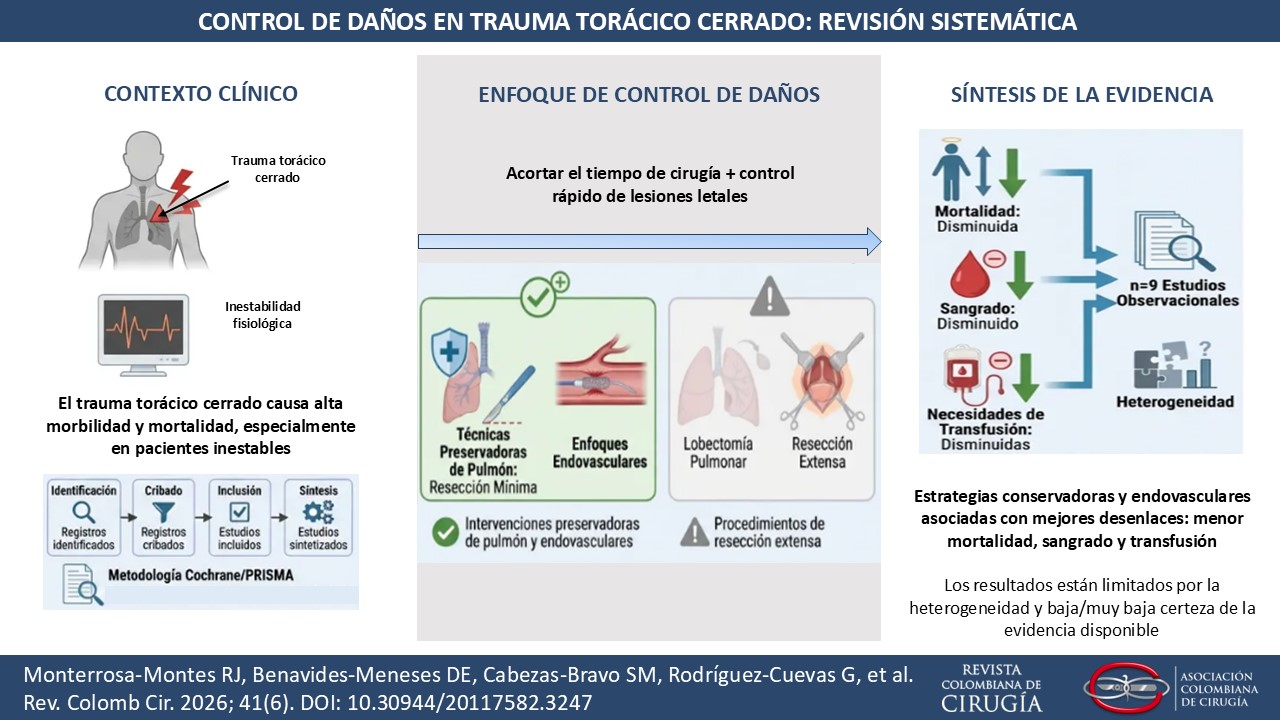
Introduction. Blunt chest trauma is associated with high morbidity and mortality, particularly in patients with physiological instability. In this context, damage control surgery aims to limit physiological deterioration by shortening operative time and rapidly controlling potential lethal injuries.
Methods. A systematic literature review was conducted following the recommendations of the Cochrane Handbook and the PRISMA 2020 guidelines. Comparative studies evaluating damage control surgery in patients with blunt chest trauma were included. The synthesis of results was performed narratively due to clinical and methodological heterogeneity.
Results. Nine comparative observational studies were included. Lung-sparing techniques and endovascular approaches were associated with lower mortality, less bleeding, and reduced transfusion requirements compared with more extensive surgical procedures. Results were heterogeneous across studies.
Conclusions. Thoracic damage control surgery was associated with favorable clinical outcomes in patients with blunt chest trauma. However, the certainty of the evidence is low to very low, so the findings should be interpreted with caution.
Downloads
References
Karmy-Jones R, Jurkovich GJ. Blunt chest trauma. Curr Probl Surg. 2004;41:211-380. https://doi.org/10.1016/j.cpsurg.2003.12.004
Moore EE, Burch JM, Franciose RJ, Offner PJ, Biffl WL. Staged physiologic restoration and damage control surgery. World J Surg. 1998;22:1184-90. https://doi.org/10.1007/s002689900542
Ivatury R, Feliciano DV, Herrera-Escobar JP. Damage control surgery: A constant evolution. Colomb Med (Cali). 2020;51:e1014422. https://doi.org/10.25100/cm.v51i4.4422
Wall MJ, Soltero E. Damage control for thoracic injuries. Surg Clin North Am. 1997;77:863-78. https://doi.org/10.1016/s0039-6109(05)70590-9
Douglas A, Puzio T, Murphy P, Menard L, Meagher AD. Damage control thoracotomy: A systematic review of techniques and outcomes. Injury. 2021;52:1123-7. https://doi.org/10.1016/j.injury.2020.12.020
Cohn SM. Pulmonary contusion: Review of the clinical entity. J Trauma. 1997;42:973-9. https://doi.org/10.1097/00005373-199705000-00033
Burlew CC, Moore EE. Resuscitative thoracotomy. In: Feliciano DV, Mattox KL, Moore EE, editors. Trauma. 9th ed. New York: McGraw-Hill Education; 2019. Chapter 17. p. 299-316.
Jones KW. Thoracic trauma. Surg Clin North Am. 1980;60:957-81. https://doi.org/10.1016/s0039-6109(16)42194-8
Higgins JPT, Thomas J, Chandler J, Cumpston M, Li T, Page MJ, et al, editors. Cochrane Handbook for Systematic Reviews of Interventions. Version 6.3. London: Cochrane; 2022.
Page MJ, McKenzie JE, Bossuyt PM, Boutron I, Hoffmann TC, Mulrow CD, et al. The PRISMA 2020 statement: An updated guideline for reporting systematic reviews. BMJ. 2021;372:n71. https://doi.org/10.1136/bmj.n71
Sterne JA, Hernán MA, Reeves BC, Savović J, Berkman ND, Viswanathan M, et al. ROBINS-I: A tool for assessing risk of bias in non-randomised studies of interventions. BMJ. 2016;355:i4919. https://doi.org/10.1136/bmj.i4919
Karmy-Jones R, Jurkovich GJ, Shatz DV, Brundage S, Wall MJ, Engelhardt S, et al. Management of traumatic lung injury: A Western Trauma Association multicenter review. J Trauma. 2001;51:1049-53. https://doi.org/10.1097/00005373-200112000-00004
Balkan ME, Oktar GL, Kayi-Cangir A, Ergül EG. Emergency thoracotomy for blunt thoracic trauma. Ann Thorac Cardiovasc Surg. 2002;8:78-82.
Ott MC, Stewart TC, Lawlor DK, Gray DK, Forbes TL. Management of blunt thoracic aortic injuries: Endovascular stents versus open repair. J Trauma. 2004;56:565-70. https://doi.org/10.1097/01.ta.0000114061.69699.a3
Hanif F, Mirza SM, Chaudhry AM. Lung sparing damage control surgery for major thoracic trauma—A 5-year experience. Eur J Trauma. 2006;32:185-9. https://doi.org/10.1007/s00068-006-6023-3
Yamane BH, Tefera G, Hoch JR, Turnipseed WD, Acher CW. Blunt thoracic aortic injury: Open or stent graft repair? Surgery. 2008;144:575-582. https://doi.org/10.1016/j.surg.2008.06.007
Geisbüsch P, Leszczynsky M, Kotelis D, Hyhlik-Dürr A, Weber TF, Böckler D. Open versus endovascular repair of acute aortic transections—a non-randomized single-center analysis. Langenbecks Arch Surg. 2009;394:1101-7. https://doi.org/10.1007/s00423-009-0468-x
Refaely Y, Koyfman L, Friger M, Ruderman L, Saleh MA, Sahar G, et al. Clinical outcome of urgent thoracotomy in patients with penetrating and blunt chest trauma: A retrospective survey. Thorac Cardiovasc Surg. 2018;66:686-92. https://doi.org/10.1055/s-0037-1608899
Chang R, Fox EE, Greene TJ, Eastridge BJ, Gilani R, Chung KK, et al. Multicenter retrospective study of non-compressible torso hemorrhage: Anatomic locations of bleeding and comparison of endovascular versus open approach. J Trauma Acute Care Surg. 2017;83:11-8. https://doi.org/10.1097/TA.0000000000001530
Gao JM, Li H, Du DY, Yang J, Kong LW, Wang JB, et al. Management and outcome of bronchial trauma due to blunt versus penetrating injuries. World J Clin Cases. 2022;10:5185-95. https://doi.org/10.12998/wjcc.v10.i16.5185
Downloads
Published
How to Cite
Issue
Section
License
Copyright (c) 2025 Revista Colombiana de Cirugía

This work is licensed under a Creative Commons Attribution-NonCommercial-NoDerivatives 4.0 International License.
Todos los textos incluidos en la Revista Colombiana de Cirugía están protegidos por derechos de autor. Las opiniones expresadas en los artículos firmados son las de los autores y no coinciden necesariamente con las de los directores o los editores de la Revista Colombiana de Cirugía. Las sugerencias diagnósticas o terapéuticas como elección de productos, dosificación y métodos de empleo corresponden a la experiencia y al criterio de los autores.


| Article metrics | |
|---|---|
| Abstract views | 245 |
| Galley views | 81 |
| PDF Views | 81 |
| HTML views | 0 |
| Other views | 0 |




















