
Use of permanent peritoneal catheter in malignant refractory ascites: A case series
DOI:
https://doi.org/10.30944/20117582.3267Keywords:
palliative care, ascites, peritoneum, indwelling catheters, quality of lifeAbstract
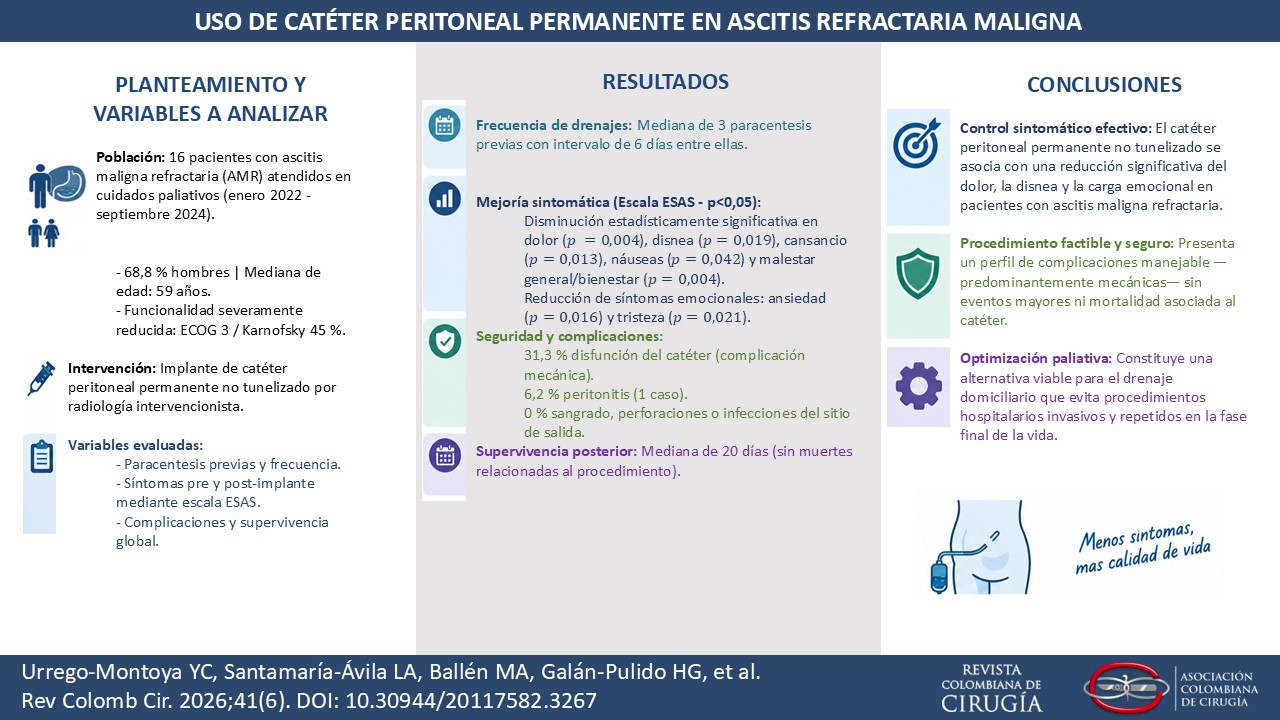
Introduction. Refractory malignant ascites impairs quality of life in patients with advanced cancer and frequently requires repeated therapeutic paracentesis. Indwelling peritoneal catheters can facilitate scheduled drainage within the context of home-based palliative care.
Methods. An observational case series study including patients treated in a palliative care program between January 2022 and September 2024. Sociodemographic variables, functional status, prior paracenteses, symptoms before and after implantation (assessed using the Edmonton Symptom Assessment System), catheter-related complications, and subsequent survival were evaluated. A descriptive analysis and an exploratory pre-post comparison using the paired Wilcoxon test were performed.
Results. In a series of 16 patients (68.8% male), the following median values were calculated: age 59 years; Eastern Cooperative Oncology Group score 3; Karnofsky score 45; three prior paracenteses (with a 6-day interval); and a subsequent survival of 20 days. Significant changes were observed in the following domains of the Edmonton Symptom Assessment System: pain (p=0.004), fatigue (p=0.013), nausea (p=0.042), sadness (p=0.021), anxiety (p=0.016), appetite (p=0.007), dyspnea (p=0.019), and well-being (p=0.004). Catheter dysfunction occurred in 31.3% of cases and peritonitis in 6.2%, with no major adverse events.
Conclusions. In this case series, the placement of a non-tunneled permanent peritoneal catheter was associated with favorable changes in symptoms reported via the Edmonton Symptom Assessment System and a low frequency of complications. These findings should be interpreted as descriptive and hypothesis-generating within the context of refractory malignant ascites and palliative care.
Downloads
References
Castaño-Cárcamo MA, Fletcher-Prieto AV. Terapia intraperitoneal paliativa en ascitis maligna refractaria. Rev Colomb Cancerol. 2018;22:18-38. https://doi.org/10.1016/j.rccan.2017.01.001
Mosquera-Klinger G, Mayo-Patiño M, Suárez Y. Paracentesis: Datos sobre la correcta utilización. Univ Med. 2018;59-1-8. https://doi.org/10.11144/Javeriana.umed59-1.para
Castiblanco-Delgado DS, Seija-Butnaru D, Quintero-Carreño V, Molina-Arteta BM. Análisis retrospectivo del uso de catéteres peritoneales no tunelizados para el manejo de la ascitis maligna refractaria: Serie de casos. Med Paliat. 2021;28:39-43. https://doi.org/10.20986/medpal.2021.1146/2020
Kaya A, Nas OF, Erdogan C. Tunneled peritoneal catheter placement in palliation of malignant ascites: A study with two different types of catheters. Biomed Res Int. 2019;2019:4132396. https://doi.org/10.1155/2019/4132396
Wu X, Rabei R, Keller EJ, King B, Kothary N, Kohi M, et al. Tunneled peritoneal catheter vs repeated paracenteses for recurrent ascites: A cost-effectiveness analysis. Cardiovasc Intervent Radiol. 2022;45:972-82. https://doi.org/10.1007/s00270-022-03103-4
Oiartzabal-Elorriaga U, Aza-Martínez I, Korta-Gómez I, Gorriño-Angulo O, Zabala-Landa R, Cisneros-Carpio S, et al. Cuidados paliativos en radiología. Sistema de drenaje peritoneal permanente como herramienta en el manejo de la ascitis maligna recurrente. Revista de la Sociedad Española de Radiología Médica (SERAM). 2022;1:9593.
Stukan M. Drainage of malignant ascites: Patient selection and perspectives. Cancer Manag Res. 2017;9:115- 30. https://doi.org/10.2147/CMAR.S100210
Cavazzoni E, Bugiantella W, Graziosi L, Franceschini MS, Donini A. Malignant ascites: Pathophysiology and treatment. Int J Clin Oncol. 2013;18:1-9. https://doi.org/10.1007/s10147-012-0396-6
Hodge C, Badgwell BD. Palliation of malignant ascites. J Surg Oncol. 2019;120:67-73. https://doi.org/10.1002/jso.25453
Christensen L, Wildgaard L, Wildgaard K. Permanent catheters for recurrent ascites—a critical and systematic review of study methodology. Support Care Cancer. 2016;24:2767-79. https://doi.org/10.1007/s00520-016-3145-y
Morita T, Tsunoda J, Inoue S, Chihara S. The Palliative Prognostic Index: A scoring system for survival prediction of terminally ill cancer patients. Support Care Cancer. 1999;7:128-33. https://doi.org/10.1007/s005200050242
Oken MM, Creech RH, Tormey DC, Horton J, Davis TE, McFadden ET, et al. Toxicity and response criteria of the Eastern Cooperative Oncology Group. Am J Clin Oncol. 1982;5:649-55. https://doi.org/10.1097/00000421-198212000-00014
Schag CC, Heinrich RL, Ganz PA. Karnofsky performance status revisited: Reliability, validity, and guidelines. J Clin Oncol. 1984;2:187-93. https://doi.org/10.1200/JCO.1984.2.3.187
Bruera E, Kuehn N, Miller MJ, Selmser P, Macmillan K. The Edmonton Symptom Assessment System (ESAS): A simple method for the assessment of palliative care patients. J Palliat Care. 1991;7:6-9. https://doi.org/10.1177/082585979100700202
Kietpeerakool C, Rattanakanokchai S, Jampathong N, Srisomboon J, Lumbiganon P. Management of drainage for malignant ascites in gynaecological cancer. Cochrane Database Syst Rev. 2019;12:CD007794. https://doi.org/10.1002/14651858.CD007794.pub3
Bleicher J, Lambert LA. A palliative approach to management of peritoneal carcinomatosis and malignant ascites. Surg Oncol Clin N Am. 2021;30:475-90. https://doi.org/10.1016/j.soc.2021.02.004
Coupe NA, Cox K, Clark K, Boyer M, Stockler M. Outcomes of permanent peritoneal ports for the management of recurrent malignant ascites. J Palliat Med. 2013;16:938- 40. https://doi.org/10.1089/jpm.2012.0535
Knight JA, Thompson SM, Fleming CJ, Bendel EC, Neisen MJ, Neidert NB, et al. Safety and effectiveness of palliative tunneled peritoneal drainage catheters in the management of refractory malignant and non-malignant ascites. Cardiovasc Intervent Radiol. 2018;41:753-61. https://doi.org/10.1007/s00270-017-1872-1
Murray FR, Gnehm F, Schindler V, Morell B, Gubler C, Kretschmer EM, et al. Permanent tunneled drainage of ascites in palliative patients: Timing needs evaluation. J Palliat Med. 2022;25:1132-5. https://doi.org/10.1089/jpm.2021.0506
Downloads
Published
How to Cite
Issue
Section
License
Copyright (c) 2025 Revista Colombiana de Cirugía

This work is licensed under a Creative Commons Attribution-NonCommercial-NoDerivatives 4.0 International License.
Todos los textos incluidos en la Revista Colombiana de Cirugía están protegidos por derechos de autor. Las opiniones expresadas en los artículos firmados son las de los autores y no coinciden necesariamente con las de los directores o los editores de la Revista Colombiana de Cirugía. Las sugerencias diagnósticas o terapéuticas como elección de productos, dosificación y métodos de empleo corresponden a la experiencia y al criterio de los autores.


| Article metrics | |
|---|---|
| Abstract views | 229 |
| Galley views | 85 |
| PDF Views | 85 |
| HTML views | 0 |
| Other views | 0 |




















