
Synchronous breast neoplasms: Invasive ductal carcinoma and contralateral multicentric borderline phyllodes tumor. Case report
Keywords:
breast neoplasms, breast ductal carcinoma, phyllodes tumor, multiple primary neoplasms, case reportsAbstract
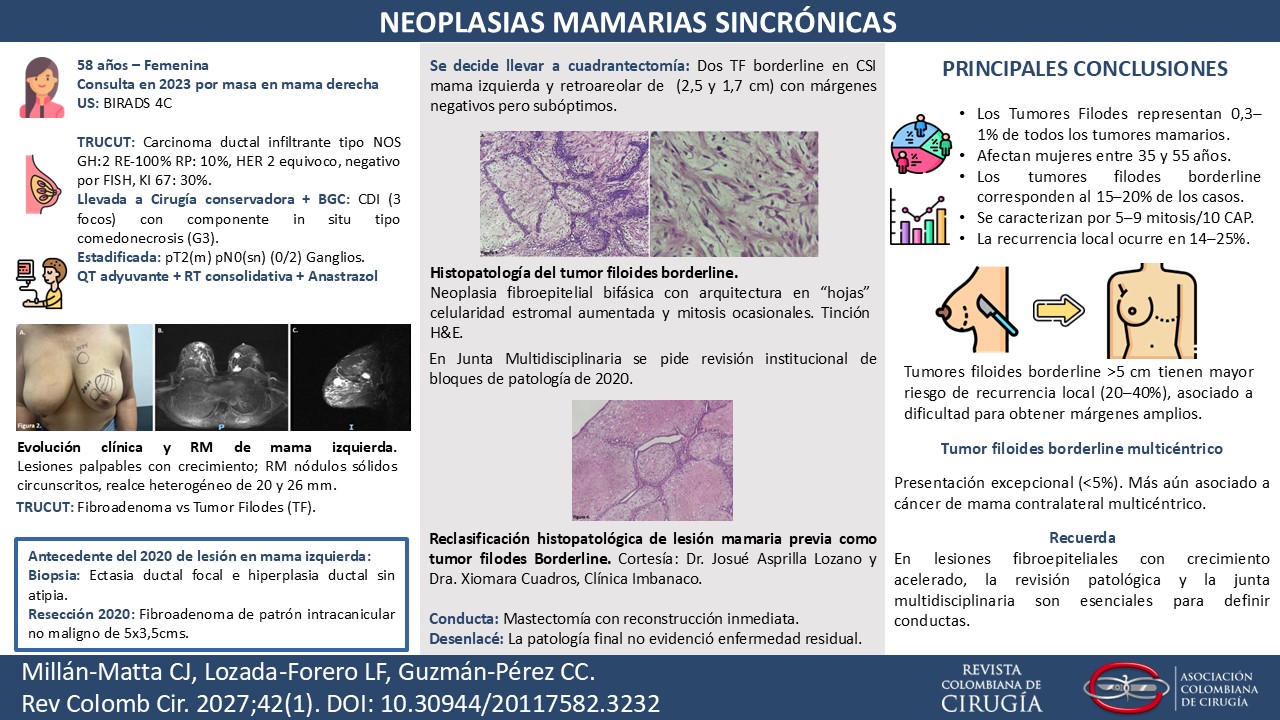
Introduction. Phyllodes tumors of the breast are rare neoplasms, accounting for less than 1% of breast tumors. The borderline variant carries a risk of recurrence. The coexistence of a borderline phyllodes tumor, the subsequent development of contralateral breast cancer, and the multifocal recurrence of the initial tumor represent an exceptional clinical scenario that raises questions regarding the underlying pathophysiology, surveillance strategies, and management of patients with complex breast pathology.
Clinical case. A 58-year-old woman with right-sided luminal B invasive ductal carcinoma diagnosed in 2023 presented, while undergoing oncological treatment, with an increase in the size of previously stable nodules in the left breast, characterized as a multicentric borderline phyllodes tumor. She had a history of a prior resection of a lesion, initially classified as a fibroadenoma, that was reclassified based on histopathology as a phyllodes tumor.
Results. The evaluation confirmed the coexistence of bilateral breast neoplasms with a multicentric pattern: right invasive ductal carcinoma and a multicentric borderline phyllodes tumor in the contralateral breast. This pattern is unusual due to the rarity of the borderline subtype, its multicentricity, and the concomitant presence of contralateral breast cancer.
Conclusion. Borderline phyllodes tumors are rare in the context of breast pathology, and their multifocal or multicentric presentation is extremely uncommon. Coexistence with contralateral breast cancer adds to the clinical complexity. This case highlights the importance of a comprehensive assessment of oncological and surgical history, histopathological review, and multidisciplinary team discussion to optimize decision-making in unusual clinical scenarios.
Downloads
References
Ihm S. ‘Robert Graves’s The Greek Myths and Matriarchy’. En: Gibson AGG, ed. Robert Graves and the classical tradition, classical presences. Oxford: Oxford Academic; 2016. p. 164-80. https://doi.org/10.1093/acprof:oso/9780198738053.003.0009
Hasdemir S, Tolunay Ş, Özşen M, Gökgöz MŞ. Phyllodes tumor of the breast: A clinicopathological evaluation of 55 cases. Eur J Breast Health. 2019;16:32-8. https://doi.org/10.5152/ejbh.2019.4709
Avatefi M, HadavandSiri F, Nazari SSH, Akbari ME. Risk factors of developing contralateral breast cancer after first primary breast cancer treatment. Cancer Rep (Hoboken). 2024;7:e1927. https://doi.org/10.1002/cnr2.1927
Reinfuss M, Mituś J, Duda K, Stelmach A, Ryś J, Smolak K. The treatment and prognosis of patients with phyllodes tumor of the breast: An analysis of 170 cases. Cancer. 1996;77:910-6. https://doi.org/10.1002/(SICI)1097- 0142(19960301)77:53.0.CO;2-6
Hsu GC, Yu JC. American College of Radiology Breast Imaging Reporting and Data System Ultrasound: An overview of the second edition. J Med Ultrasound. 2015;23:117-119. https://doi.org/10.1016/j.jmu.2015.07.003
Yu CY, Huang TW, Tam KW. Management of phyllodes tumor: A systematic review and meta-analysis of real-world evidence. Intl J Surg. 2022;107:106969. https://doi.org/10.1016/j.ijsu.2022.106969
Corso D, Contreras D, Javier Á, Guzmán L, Díaz S, García O, et al. Tumor filoide. Estado del arte. Rev Colomb Cancerol. 2016;20:79-86. https://doi.org/10.1016/j.rccan.2015.10.001
Tan PH, Ellis I, Allison K, Brogi E, Fox SB, Lakhani S, et al. The 2019 World Health Organization classification of tumours of the breast. Histopathology. 2020;77:181-5. https://doi.org/10.1111/his.14091
Chaney AW, Pollack A, McNeese MD, Zagars GK, Pisters PW, Pollock RE, et al. Primary treatment of cystosarcoma phyllodes of the breast. Cancer. 2000;89:1502-11. https://doi.org/10.1002/1097-0142(20001001)89:7 3.0.co;2-p
Mitus JW, Blecharz P, Jakubowicz J, Reinfuss M, Walasek T, Wysocki W. Phyllodes tumors of the breast. The treatment results for 340 patients from a single cancer centre. Breast. 2019;43:85-90. https://doi.org/10.1016/j.breast.2018.11.009
Tan BY, Acs G, Apple SK, Badve S, Bleiweiss IJ, Brogi E, et al. Phyllodes tumours of the breast: A consensus review. Histopathology. 2016;68:5-21. https://doi.org/10.1111/his.12876
Hassouna JB, Damak T, Gamoudi A, Chargui R, Khomsi F, Mahjoub S, et al. Phyllodes tumors of the breast: A case series of 106 patients. Am J Surg. 2006;192:141-7. https://doi.org/10.1016/j.amjsurg.2006.04.007
Downloads
Published
How to Cite
Issue
Section
License
Copyright (c) 2025 Revista Colombiana de Cirugía

This work is licensed under a Creative Commons Attribution-NonCommercial-NoDerivatives 4.0 International License.
Todos los textos incluidos en la Revista Colombiana de Cirugía están protegidos por derechos de autor. Las opiniones expresadas en los artículos firmados son las de los autores y no coinciden necesariamente con las de los directores o los editores de la Revista Colombiana de Cirugía. Las sugerencias diagnósticas o terapéuticas como elección de productos, dosificación y métodos de empleo corresponden a la experiencia y al criterio de los autores.
Altmetric

| Article metrics | |
|---|---|
| Abstract views | 1 |
| Galley views | 1 |
| PDF Views | 1 |
| HTML views | 0 |
| Other views | 0 |




















